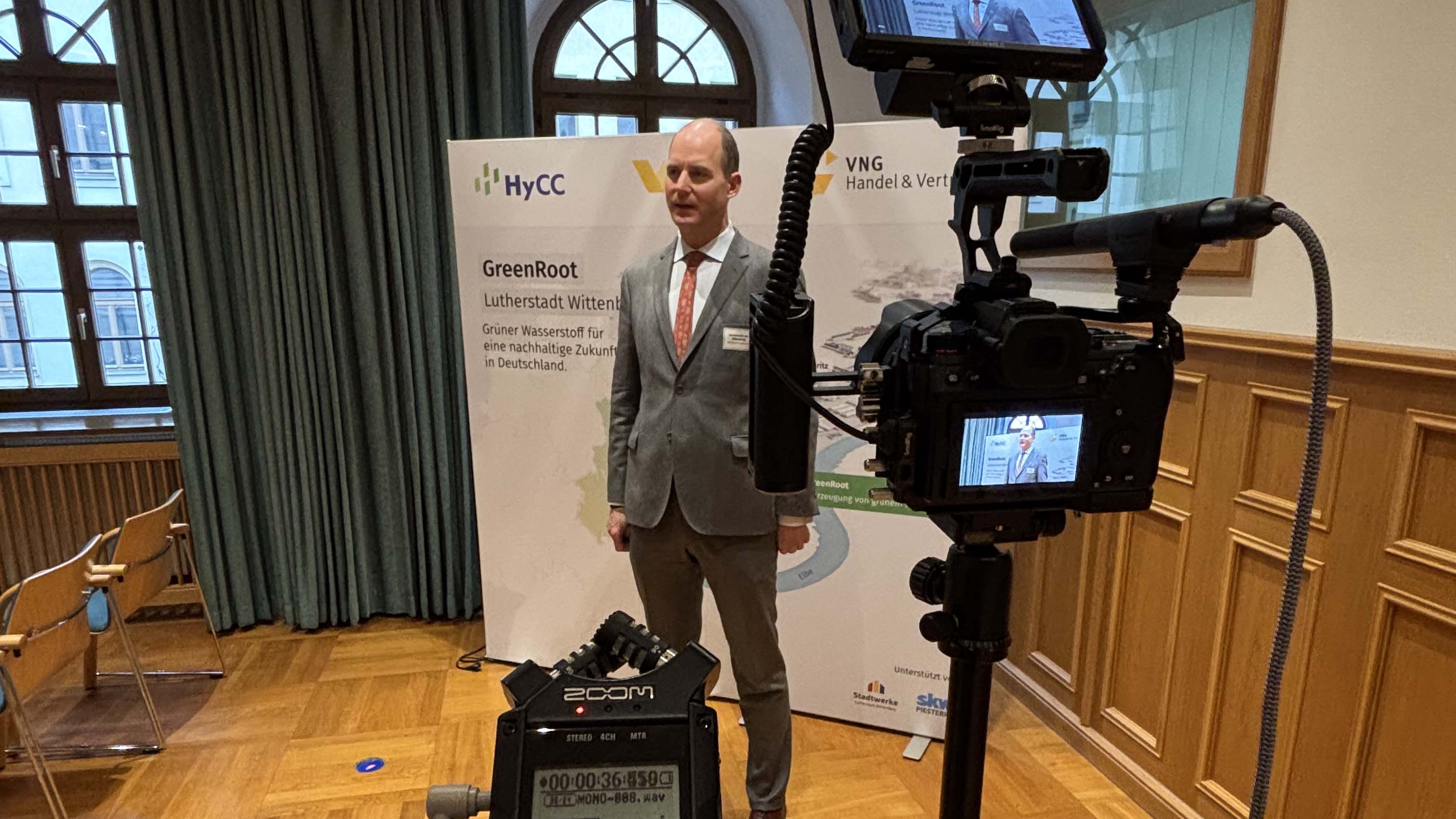
How I shoot employee statements without anyone freezing up
Memorised sentences almost always sound worse on camera than spontaneous ones. Why I'd rather let people just start talking — and the small thing at the start that makes the biggest difference.
Before every employee interview, there's that one moment when the person first looks into the camera. And briefly doesn't know what to do with their hands.
I know it. I see it every time.
Some are standing in front of a camera for the first time. Some don't really want to be there and only are because they were asked and didn't want to say no. Some don't know what they're supposed to say at all. And some come especially prepared, with a finished text on their phone that they've memorised.
Those last ones are often the hardest.
Memorised sentences almost always sound worse on camera than spontaneous ones. They're stilted, the eyes drift upward as the head searches for the next half-sentence. As soon as a word is missing, the person starts over. With every repetition it gets less confident, not more.
That's why I explain right at the start that I don't want that.
I ask my questions spontaneously. The person hears the question for the first time and lines up an answer in their head. That's bumpy at first, of course. But that short searching, that thinking, is what later looks real. After two or three questions, everyone slides into a flow. Answers get longer, clearer, more personal.
Before we start, I take the pressure off.
I explain that the person isn't looking into the camera, they're looking at me. We just have a conversation, as if the lens next to us weren't even there. The camera runs the whole time. I don't start and stop between questions. Anyone who stumbles shouldn't flinch. Slip-ups aren't a problem. I cut them out later.
That one sentence visibly loosens many people up. Shoulders drop. Breathing slows. Suddenly it's allowed to trip over your words.
If a sentence doesn't land, nobody should patch on the same half-sentence again. That makes the edit impossible later. Instead, just start over or come back in at a logical point. I note which take is the good one, and in the edit suite I put everything together cleanly.
That gives the person the freedom to correct themselves without the mood collapsing.
There's one thing I explain to every employee before the first take — and it's what makes the biggest difference in the finished video.
My questions usually aren't audible in the edit. Nobody sees a title card saying "What are your employee benefits?". The audience has to understand from the answer what it's about.
So I ask the person to pick up the question indirectly.
If I ask "What are your employee benefits?", the answer shouldn't be: "30 days of vacation and a job bike." It should be: "Our employee benefits are 30 days of vacation and a job bike."
That's a small thing, and in the edit it makes the difference between a real statement and an incoherent snippet.
While we talk, I don't just listen, I watch. I notice when someone is really on an answer and when they're just running through it. I notice when something is real because the face changes. And in those moments I follow up deliberately. "Could you say that again the way you just did, that was great." Or: "How was it exactly when you first experienced that?"
The best statements often only show up at the fourth or fifth question. Not the first. That's exactly why the camera keeps running.
At the end of a statement, the person almost always walks out differently than they walked in. They've heard themselves talk. They've said something about their work that maybe doesn't get said every day. And in the moment they leave the room, they usually say the same sentence: it wasn't nearly as bad as I thought.
That feeling is exactly my job.
Because in the end, what you see in the finished film isn't the camera, the lights or the question. You just see a person talking about something that matters to them. And that only works if they didn't have to freeze up first.
MORE INSIGHTS
Why visibility without trust doesn't move the needle — and how a film builds both
On how reach, trust and an employer brand that actually attracts candidates connect. And why video isn't an end in itself — it's a tool.
WorkflowWhat to think about before you have me produce a film for you
On briefings, budgets and the questions that actually matter.
WorkflowGoodbye SSD chaos — why I rebuilt my storage setup from scratch
Sometimes you suddenly notice that a system isn't growing with your work anymore. On the moment chaos turned into structure — and why a new NAS is my workflow upgrade of the year.