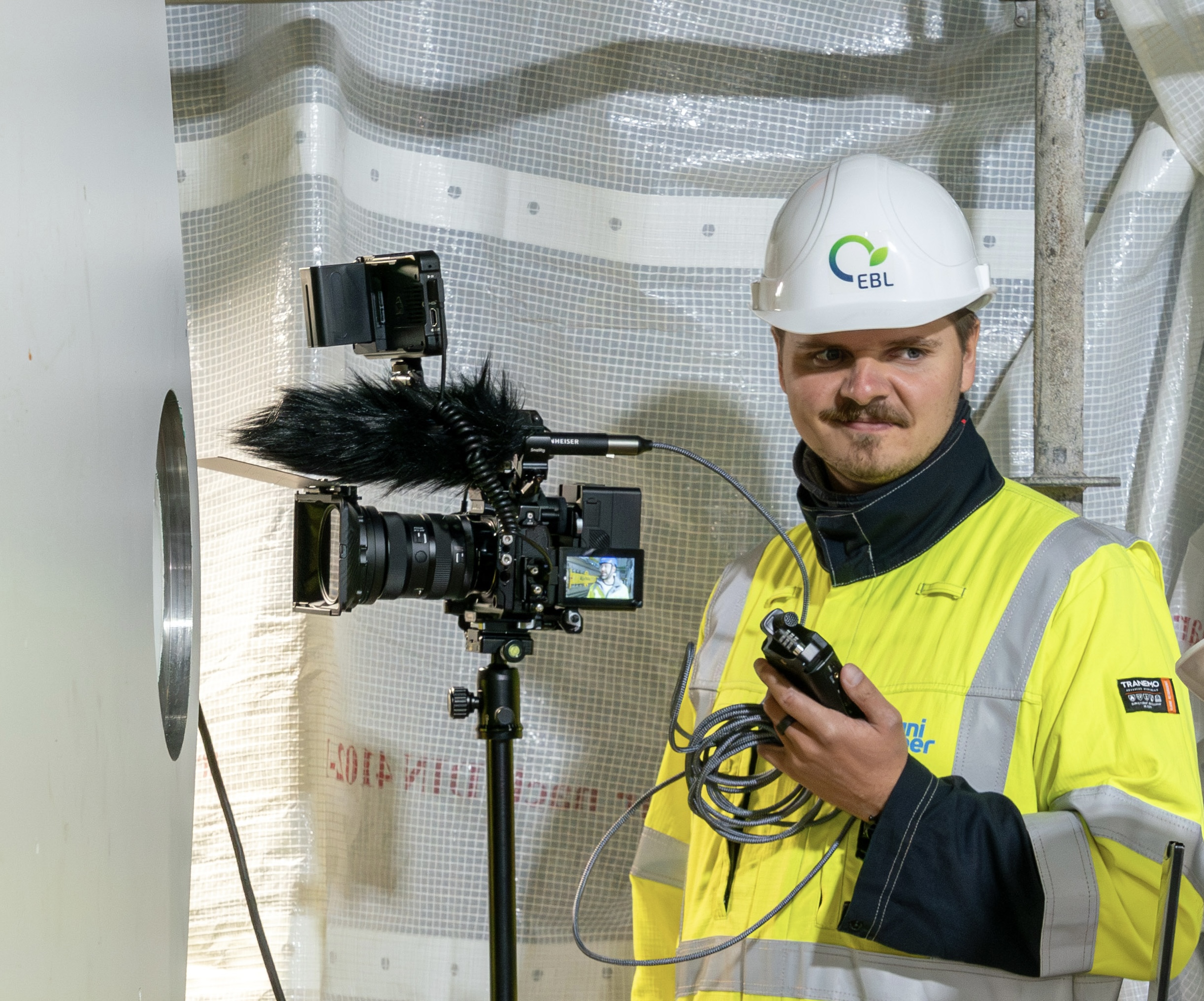
How AI regularly has my back when it comes to audio
Sometimes things don't go to plan. Wind, noise, no second take — and the interview still has to be usable. How AI tools fundamentally changed my audio workflow.
Why good on-location audio matters — and why AI is still indispensable
Sometimes things just don't go to plan.
You're standing outside, doing a spontaneous interview, you've got your boom mic with deadcat and you're actually well prepared. And still the wind howls through the mic. Somewhere in the background a pallet truck rolls by, someone is drilling, doors slam, voices echo. Things that are part of that moment and can't simply be switched off.
A second take often isn't an option. The moment is gone. The person has to move on. The programme rolls. Especially at events or appointments with little time, it's decided in seconds whether an interview happens or not.
That's where the tightrope between authenticity and technical reality begins.
I work a lot on location. At events, at companies, at client appointments that weren't built for film production. And that's exactly what makes these situations valuable. The atmosphere, the impressions, the real people. You can't recreate any of that in a studio. If you want to show authentic insights, you have to go out and shoot where life is actually happening.
The price for that is noise.
I used to try to solve this problem the classical way in post. Hours in Audition with EQs, noise gates, denoisers, manual frequency work. A lot of time, a lot of fine work, and often a result that was better but not really good. Especially when several disturbances were happening at once.
Today I handle it differently.
AI tools like LALAL.AI have fundamentally changed the way I work with audio. Not because they're magic, but because they go exactly where classical tools hit their limits. I upload the audio file and have speech and ambient noise separated. Two tracks, cleanly split.
I layer the two tracks, lower the background by about fifteen to twenty decibels, and suddenly the audio sounds like an interview again. Not like a construction site, not like an event hall, but like a conversation between two people.
Of course it isn't a cure-all. Sometimes the AI eats a syllable or swallows a word. In those cases, putting music or atmos underneath helps. And honestly: in a finished video, nobody hears the audio in isolation. It always sits in the context of picture, music and editing. And that's exactly where this solution works brilliantly.
What's essential for me is that AI here supports, it doesn't replace.
I don't want to synthesise interviews from scratch. I don't want to swap voices or fabricate emotion. The opposite. I want to save real situations. Situations that are worth showing, even if the conditions weren't perfect.
Because perfection is rarely something you find on location.
At events especially, volume is part of reality. People talk, gear runs, rooms reverberate. You can get the mic as close as you want, at some point you hit the laws of physics. And exactly there, AI-supported tools help me enormously.
In Premiere too, I now regularly use the built-in speech enhancement. Small interventions, targeted optimisations, without destroying the character of the voice. The audio stays real, but becomes intelligible. That's the goal in the end.
I think it's important to draw a clear line. AI doesn't replace clean work on location. It doesn't replace good miking, doesn't replace a deliberate choice of location, doesn't replace experience. But it expands the room I have to work with. It gives me the confidence to shoot even when conditions are difficult.
And that confidence is exactly what my clients need.
Many of the people I work for value that I'm flexible. That I engage with situations that can't really be planned. That I deliver even when the schedule is tight and the surroundings aren't ideal. They know that in the end a result will come out that works.
Not because I leave everything to AI, but because I know where it can be used sensibly.
Of course there are productions where this isn't enough. Big film projects, elaborately planned shoots, situations where absolute control is needed. There the environment has to be quiet, things are planned differently, different standards apply.
But most of my work doesn't happen under lab conditions. It happens in the middle of everyday life. And that's exactly what these tools are made for.
In the end it's always about authenticity for me. About real impressions, real emotions, real people. AI helps me make that authenticity audible, not replace it.
Maybe that's the most important point. Technology is allowed to support, but it can't take over the story. It's a means to an end. Nothing more, nothing less.
And if it regularly has my back doing exactly that, then that's what I use it for.
MORE INSIGHTS
Why visibility without trust doesn't move the needle — and how a film builds both
On how reach, trust and an employer brand that actually attracts candidates connect. And why video isn't an end in itself — it's a tool.
WorkflowWhat to think about before you have me produce a film for you
On briefings, budgets and the questions that actually matter.
WorkflowGoodbye SSD chaos — why I rebuilt my storage setup from scratch
Sometimes you suddenly notice that a system isn't growing with your work anymore. On the moment chaos turned into structure — and why a new NAS is my workflow upgrade of the year.